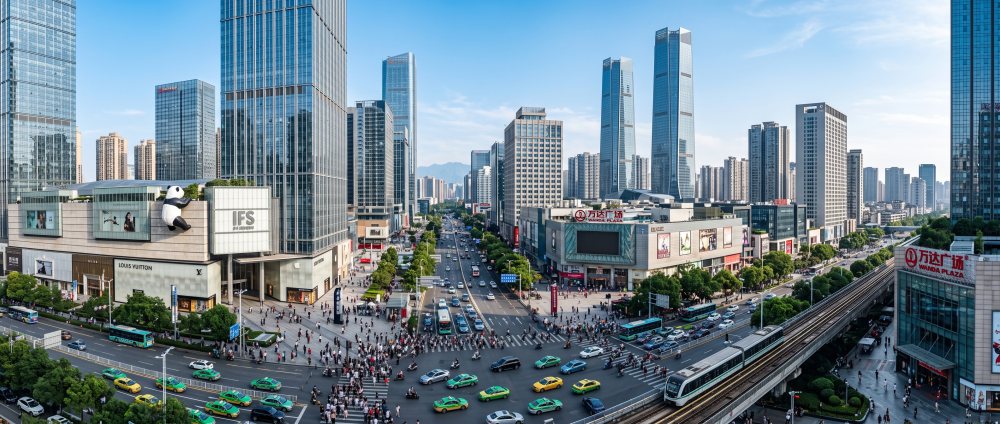
On September 6, 2026, the Sichuan Provincial People’s Government released the 15th Five-Year Plan for Integrated Development of the Chengdu Metropolitan Area. The plan sets out a comprehensive framework for spatial development, industrial coordination, innovation, transport connectivity, market integration, public services, ecological governance, urban-rural integration and implementation mechanisms.
By 2030, GDP in the Chengdu Metropolitan Area is targeted to reach RMB 3.95 trillion, while the combined GDP of Chengdu, Deyang, Meishan and Ziyang is expected to reach RMB 4.1 trillion. Annual air passenger throughput is expected to exceed 100 million, and more than 75% of the population is expected to live within areas that offer one-hour commuting access.
1. Overall Goals and Spatial Structure: Chengdu as the Core, with Deyang, Meishan and Ziyang as Supporting Centers
The plan aims to build a modern metropolitan area that is innovative, livable, beautiful, resilient, culturally vibrant and smart.
Spatially, it proposes a networked structure consisting of Chengdu as the core city, Deyang, Meishan and Ziyang as secondary centers, together with county-level urban clusters.
Chengdu will strengthen its functions in innovation, international connectivity and emerging industries. Deyang will focus on high-end energy equipment manufacturing. Meishan will prioritize lithium batteries, photovoltaics and new chemical materials. Ziyang will develop aerospace, digital intelligence, clean energy and new materials.
The plan also calls for stronger integration in border areas between the four cities, including joint projects, public service coordination and shared municipal infrastructure.
2. Industry and Innovation: From Supply-Chain Coordination to Joint Parks, Funds and Technology Transfer
Industrial cooperation occupies a major part of the plan.
The metropolitan area will jointly develop advanced manufacturing clusters in sectors such as electronic information and high-end energy equipment. Priority industrial chains include green food processing, textiles and footwear, high-end energy equipment, lithium batteries, rail transit, intelligent connected and new-energy vehicles, aerospace, biomedicine, dental medical devices, new displays, new materials, low-altitude economy and artificial intelligence.
The plan also promotes coordinated development in modern services, metropolitan agriculture and tourism. In agriculture, it proposes the development of 100,000 mu of grain and oil production belts, 100,000 mu of grain and oil industrial parks, and 222 high-standard 1,000-mu grain production zones, while keeping the agricultural product quality and safety qualification rate above 98%.
More importantly, the plan moves beyond general industrial coordination toward mechanisms for sharing investment, risks and benefits.
It proposes the establishment of a metropolitan industrial development fund, supports cross-jurisdiction industrial parks through joint investment, entrusted operation and paired cooperation, and calls for experiments with fiscal and tax revenue sharing in sectors and cooperation parks such as liquor and chemicals. It also proposes mechanisms for sharing the risks and costs of investment in future industries.
On innovation, the plan calls for developing the Tianfu Avenue Science and Technology Innovation Corridor, the Chengdu-Chongqing (Xinglong Lake) Comprehensive Science Center and the Western China (Chengdu) Science City. It also proposes an integrated “online innovation platform + offline innovation islands” system and the joint development of the Western China Pilot-Scale Testing Center.
3. Transport Integration: Turning the “One-Hour Metropolitan Area” into a Working System
Transport remains the most direct foundation for metropolitan integration.
The plan calls for closer integration of four railway systems: national railways, intercity railways, suburban railways and urban rail transit. It will continue building the “two rings and three radial corridors” rail network and the “three ring expressways and twenty radial expressways” highway network, while removing missing links and bottlenecks across the metropolitan area.
Major projects include the Chengdu-Chongqing Central Line High-Speed Railway, the Chengdu-Dazhou-Wanzhou High-Speed Railway, the Chengdu-Meishan suburban railway and the Chengdu-Deyang suburban railway. The Chengdu Outer Ring Railway is also under study.
Operational integration is equally important. Cross-city bus services are expected to achieve full coverage of integrated fare payment and preferential pricing, while the plan also explores cross-jurisdiction passenger services for taxis and ride-hailing vehicles. Common technical standards, construction schedules and operating rules will be further coordinated across cities.
These measures directly support the target of having more than 75% of the population within one-hour commuting reach by 2030.
4. A Unified Market and Shared Public Services: Making Mobility Across City Boundaries Easier
The plan treats market integration and public service sharing as separate chapters, but together they address the same issue: what happens after people and businesses begin moving more freely across city boundaries.
For the unified market, the plan promotes mutual recognition of household registration qualification years and residence permits. It also proposes allocating new construction land according to population and industrial trends, and exploring the cross-city transfer of surplus urban-rural construction land quotas and land quota generated through the “increase-decrease linkage” system.
Business registration, relocation procedures, government services, licensing and market supervision will also be further standardized across jurisdictions.
For public services, the plan explicitly proposes a mechanism under which “public services follow people.” Facilities are to be planned according to permanent population and service radius, with higher-quality services in Chengdu gradually extending into Deyang, Meishan and Ziyang.
In education, the plan explores a 12-year integrated education model from primary through senior high school and a policy allowing migrant children to enroll immediately upon arrival. Chengdu’s high-quality schools are encouraged to form partnerships with schools in the other three cities.
In healthcare, tertiary hospitals in Chengdu are encouraged to establish cooperative relationships and medical alliances with institutions in Deyang, Meishan and Ziyang.
5. Ecology, Governance and Urban-Rural Integration
The plan uses the “three mountains and two rivers” — Longmen Mountain, Qionglai Mountain, Longquan Mountain, the Min River and the Tuo River — as the ecological framework for cross-city coordination.
It calls for better connections between ecological corridors and greenways, stronger nature reserve and ecological restoration systems, and joint prevention and control of pollution in cross-boundary rivers, the atmosphere and soils.
On smart governance, the plan proposes coordinated development of computing infrastructure, research and application of 6G, and stronger systems for urban lifelines, emergency response, energy security, water security and community governance.
Urban-rural integration focuses on household registration reform, rural property rights, talent mobility, industrial integration and the extension of public services to rural areas.
The plan also includes measures on external opening-up, including upgrading pilot free trade zones, strengthening coordinated reform zones, improving international logistics and expanding platforms for international exchange.
6. Implementation: Rolling Project Reserves and Dynamic Management
For implementation, the plan requires overall and sectoral targets to be translated into annual tasks, supported by dynamic monitoring, mid-term evaluation and final assessment.
Major projects will be managed through a rolling pipeline of projects under construction, projects to be started and reserve projects, with annual updating, dynamic adjustment and tiered management. Projects included in the reserve pipeline will receive priority consideration for inclusion in provincial key project lists.
Land and other major resources will also give priority to cross-city industrial projects and public facilities.
Overall, the plan shows that integration in the Chengdu Metropolitan Area is moving beyond physical connectivity. The next stage places greater emphasis on cross-city commuting rules, industrial benefit-sharing, portable public services and cross-jurisdiction allocation of resources.
In other words, the depth of metropolitan integration will increasingly depend not only on infrastructure, but on whether institutional boundaries between cities can also become easier to cross.
Urban China links reporting and commentary to original policy documents wherever available. Check publication dates, issuing bodies and subsequent revisions when using a source.